


Ghibli Park is absolutely worth it as an adult 🌽
Hello to all Ghibli fans visiting from abroad! In this article, I’ll walk you through everything you need to plan your visit with confidence: how long to spend in each area, how the food situation actually works, and — most importantly — what time slot to book for Ghibli’s Grand Warehouse. I’ve also put together two model itineraries based on my own real experience, so I hope they’re helpful!

Hi there! I’m Shimakuma 🐻, a Japanese travel blogger based in Japan🇯🇵. Everything in this article comes from my own boots-on-the-ground experience — failures and all.
What you’ll learn from this article:
- How the ticket time slot system works (and how I got it wrong the first time)
- Estimated duration for each of the 5 areas, based on my actual visit
- Walking time between areas — the most underrated thing to plan for
- Tips to skip the lines without waking up at the crack of dawn
- Food rules inside the park: what’s allowed, what isn’t, and where to eat
- Two model itineraries: one day and two days
Note: All of this is based on my personal experience on weekdays. Conditions may vary by season, crowd level, and group composition. If you’re visiting with young children, please be aware that some areas have child-only zones and experiences, so the planning will look quite different.
What Is the “Assigned Entrance Times” on the Ticket?
You’ll need to select “Assigned Entrance Times” at the time of booking —— but only for one specific area: Ghibli’s Grand Warehouse.
Assigned Entrance Times (only for Ghibli’s Grand Warehouse)
https://ghibli-park.jp/en/ticket/
9 a.m. (*) / 10 a.m. / 11 a.m. / 12 p.m. / 1 p.m. / 2 p.m. / 3 p.m.
(9:00 is only available on days the park opens at 9:00)
And it cannot be changed later.
For first-time visitors, this is a surprisingly easy thing to get wrong. I speak from experience:
I chose the wrong time slot on my first visit and ended up losing some precious park time as a result.
Here’s the key thing to understand: your Grand Warehouse time slot should be decided after you’ve figured out how you want to spend the rest of your day. You need to plan your full route first, then work backwards to choose the right entry time for the Warehouse. If you book before thinking it through, you might end up either rushing through other areas or waiting around with nothing to do. More on why this matters below.
Before You Book: A Helpful Resource

 ポチップ
ポチップ
I highly recommend doing a little prep with the official Ghibli Park guidebook before purchasing your tickets. But don’t worry! I’ll break everything down for you below, so you’ll understand exactly what to do even if you don’t have the book on hand yet.
So let’s start with the time estimates for each area.
How Long Does Each Area Take? (Based on My Real Visit)
Ghibli Park is located inside Aichi Earth Expo Memorial Park — a vast outdoor space that honestly surprised me with its scale the moment I started walking around. To make the most of your time, it’s essential to have a rough sense of how long each area takes, plus how long it takes to travel between them.
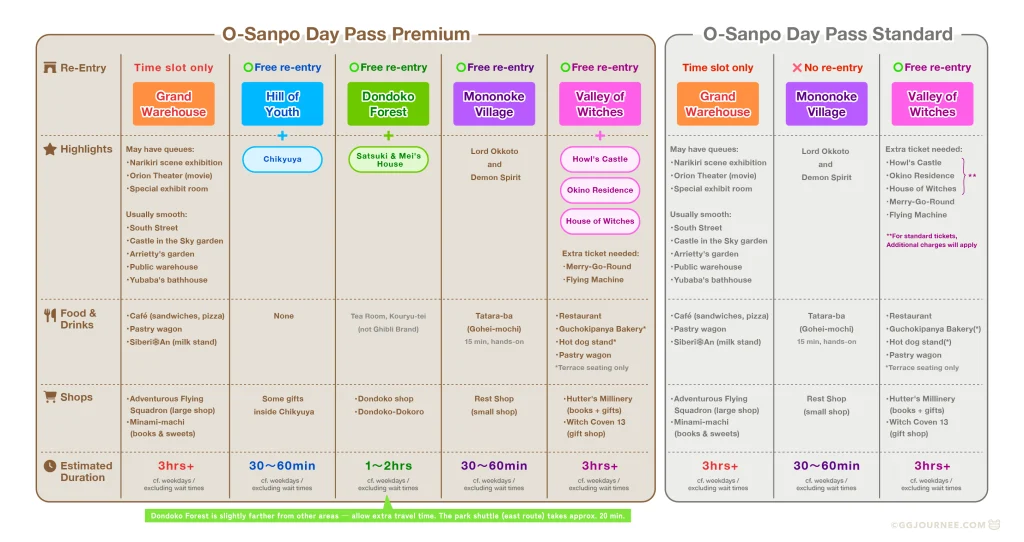
🐻 Here’s how long I actually spent in each area, not including wait times:
* I visited the park three days in a row.
| Area | Time Spent |
|---|---|
| Ghibli’s Grand Warehouse | 1.5 hrs (Day1*) + 5 hrs (Day3) = 6.5 hrs total |
| Hill of Youth | 60 min (including shelter from rain) |
| Dondoko Forest | 2 hrs (including a 10-min Catbus ride) |
| Mononoke Village | 60 min (including a 15-min Gohei-mochi making experience) |
| Valley of Witches | 3.5 hrs (Day1*) + 4 hrs (Day2) = 7.5 hrs total |
As you can see, the Grand Warehouse and the Valley of Witches are both genuinely half-day (or more) destinations. Don’t underestimate them.
Travel Time Between Areas: The Most Overlooked Part of Planning
The park is much larger than it looks on the map. I’ve put together a travel time chart based on my own walks (and one Catbus ride). In short: budget a lot of minutes of walking between most areas, and factor that into your timeline.
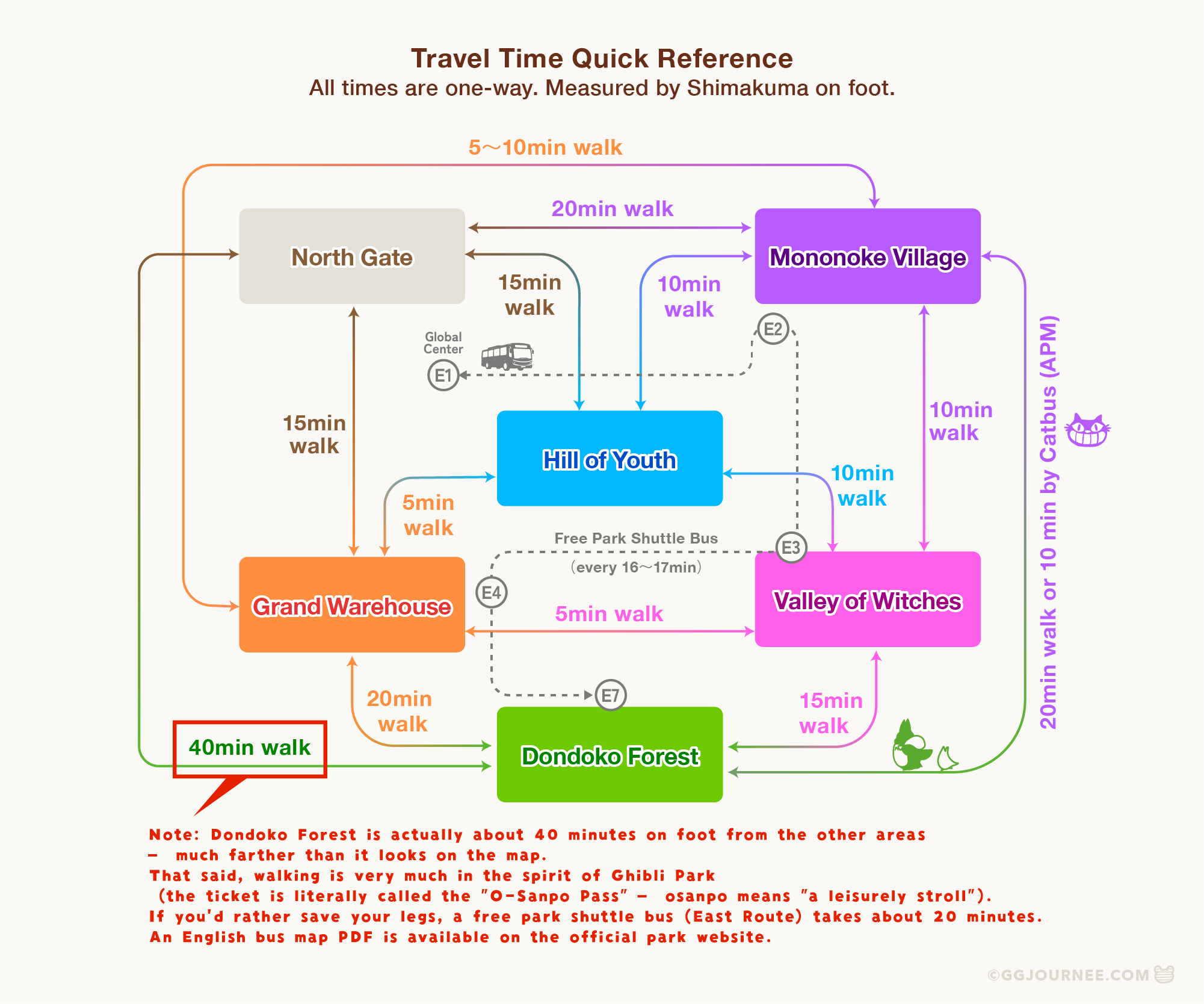
Note: 🚌 Free Park Shuttle Bus
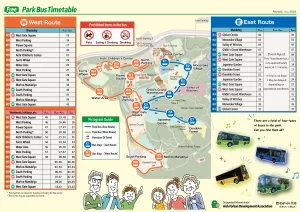
A free park shuttle bus (East Route) takes about 20 minutes from North Gate(E1) to Dondoko Forest(E7). An English bus map PDF is available on the official park website.
Note: 🐈Catbus(APM)
Dondoko Forest is actually about 40 minutes on foot — much farther than it looks on the map. Walking is very much in the spirit of Ghibli Park (the ticket is literally called the “O-Sanpo Pass” — osanpo means “a leisurely stroll”). If you’d like to save your legs, the APM Catbus connects Mononoke Village to Dondoko Forest in about 10 minutes (¥1,000 per ride, one-way). Riders receive a special illustrated card drawn by Hayao Miyazaki himself — a nice bonus!

Ghibli Park Full Map
Massive Lines?! Here’s How to Avoid Them

There Are Two Types of Wait Times at Ghibli Park
It’s worth knowing that waiting at Ghibli Park happens in two different forms:
- Waiting to enter an area (the queue outside the area gate)
- Waiting for a specific attraction or shop inside an area
Ghibli Park’s catchphrase is “Please Come Slowly.” in Japanese. Having now returned from my three-day visit, I completely understand what they mean by that.
Even on weekdays, massive lines were forming over an hour before opening — especially at the Grand Warehouse and the Valley of Witches. And yet, across all three days, I never once stood in those entrance lines. Here’s how.

Grand Warehouse: Wait 20 Minutes After Your Time Slot Starts
Entry into the Grand Warehouse begins exactly on the hour for each time slot. According to a staff member I spoke with, the first 20 minutes of every slot are the most crowded — and once that initial rush passes, you can walk straight in with almost no wait.
I tested this advice and it worked perfectly. In those 20 minutes, you have more than enough time to head over to Mononoke Village for the Gohei-mochi experience! It’s only about 5–10 minutes on foot from the Grand Warehouse, so there’s no need to rush. If you have a Premium Ticket, you can re-enter areas freely — so you could grab your Gohei-mochi first thing in the morning and explore Mononoke Village properly later.
Gohei-mochi is a traditional Japanese skewered rice cake coated in sweet miso or soy-based sauce, grilled over charcoal. At Mononoke Village, you can grill your own in a hands-on experience — it’s one of the most memorable things I did at the park.

Note: this is based on weekday observations only. Weekends may be more crowded throughout.
Valley of Witches: Just Go in the Afternoon

This one might feel counterintuitive. The Valley of Witches has the rarest merchandise, the park’s official restaurant, and the most paid attractions — so the instinct is to rush there first thing in the morning.
But in practice, going in the afternoon worked out just fine. Here’s why:
- Most people lining up first thing in the morning are after the limited-edition items. But don’t worry! There is plenty of other merchandise in stock, and you’ll be more than satisfied with those.
- The most popular bakery, Guchokipan Bakery (inspired by Kiki’s Delivery Service), still had inventory when I visited in the afternoon on weekdays.
- Howl’s Moving Castle, the Okino Residence (Kiki’s family home), and the House of Witches are all included with a Premium Ticket — no need to queue for same-day entry tickets, which saves a significant amount of time.
Same-day Tickets for Valley of Witches Designated Buildings
Same-day tickets are required to enter Okino Residence, Howl’s Castle and The House of Witches. (Ghibli Park O-Sanpo Day Pass Premium holders are not required to purchase additional tickets for entry into the designated buildings.)
▼Okino Residence and The House of Witches
From 10:30 a.m. (9:30 a.m. on weekends and holidays) to 4:30 p.m. Same-day tickets go on sale at the Ticket Truck in Valley of Witches.
▼Howl’s Castle
At 10:00 a.m. (9:00 a.m. on weekends and holidays), Exchange Vouchers which indicate a specific sale time will be distributed near the Ticket Truck in Valley of Witches.
The Exchange Voucher can be used to purchase the Same-day Ticket. You can purchase the Same-day Ticket from the time indicated on your voucher until 4:30 p.m. at the Ticket Truck in Valley of Witches.
Exchange vouchers with the earliest sales times are distributed first, on a first-come first-served basis.https://ghibli-park.jp/en/ticket/
Please note that the number of tickets is limited, and sales will end once tickets are sold out. Thank you for your understanding.
Sales may be temporarily suspended due to crowding.
* The Same day Tickets are only available to those holding a valid ticket for Valley of Witches on the same date.
* In order to avoid crowd related accidents, please remain calm as you move throughout the park.
Souvenir Shops: Afternoons Are Fine (Unless You’re Chasing Ultra-Rare Items)
For both the Grand Warehouse and the Valley of Witches, afternoon shopping on weekdays was essentially queue-free. If you’re not specifically hunting for limited-edition releases, there’s no need to rush to the shops first thing.
And fair warning: if this is your first visit, the temptation to buy everything is very real. There are so many park-exclusive items that don’t qualify as “ultra-rare” but are still completely unavailable anywhere else. You will absolutely find something you love 🐾

Food Rules: What You Can and Can’t Eat Inside the Park
This is one of the most important things to understand before you arrive, and it genuinely surprises people.
The short version: you can carry your own snacks and drinks in your bag, but eating your own food inside any of the paid areas is not allowed. Staff will politely but firmly stop you if they see it — and I personally witnessed this happening to someone nearby.
The five paid areas are: Grand Warehouse, Hill of Youth, Dondoko Forest, Mononoke Village, and Valley of Witches.

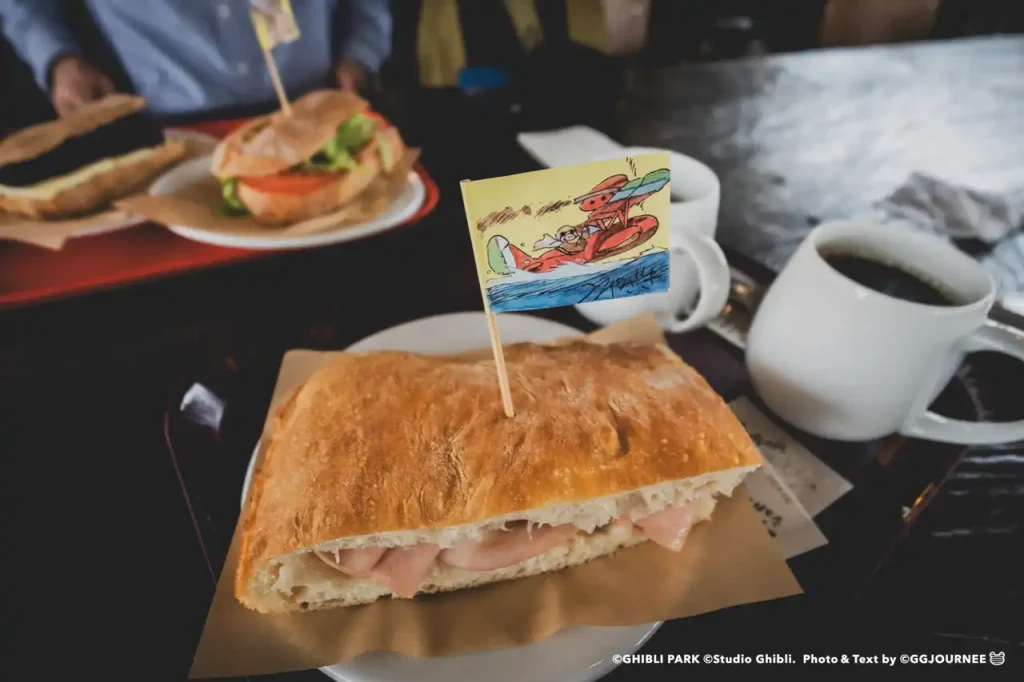
Inside the Grand Warehouse specifically, the only food you can eat is the milk and castella cake sold at a small shop called “Siberi❆An” inside the building. The café (Transcontinental Air Café) is located on an outdoor terrace-like area attached to the Warehouse, not inside it. Sealed beverages with caps are fine to bring into paid areas — just keep them away from the exhibits.
One more thing: there are no trash cans inside the park. You are expected to take all your garbage home with you. (There are a few bins near food wagons, but these appear to be specifically for food wagon waste.)
Where to Eat: Use the Free Areas
Ghibli Park’s layout is actually scattered across a large public park — the paid areas are separate zones distributed throughout the grounds. Between those zones are what’s called the “Free Areas” (free as in no ticket required), and these are where you’ll find the most practical dining options.
Free Area dining options:
- North Gate area: convenience store, onigiri (rice ball) shop, café
- Mikazuki Rest Area: food trucks
- Beneath the ice skating rink: a kishimen noodle restaurant (kishimen is a flat, wide udon-style noodle dish from Nagoya), plus a rest space with vending machines
On a sunny day, the large lawn areas are perfect for a picnic lunch with something from the convenience store. Do bring a hat or parasol — UV exposure is strong out in the open.
On a rainy day, I’d especially recommend the kishimen restaurant under the ice rink. It’s warm, it has seating, and it’s one of the few genuinely sheltered options on-site. I had my bento lunch from JTB there during a rainy spell, and it was actually quite lovely — almost like hanami (cherry blossom viewing) mood, despite the rain 🌸

Important note on timing for in-park dining: The restaurants and cafés inside the paid areas (like the Flying Oven in the Valley of Witches, Guchokipanya Bakery, and the Transcontinental Air Café) do get very busy in the morning and around lunchtime. If you go too late, some food menu items may be sold out. The afternoon sweet spot — roughly 14:00 onwards on weekdays — tends to have shorter queues but fewer hot meal options.
Getting to the Park: Navigating Nagoya Station
One thing I didn’t anticipate: heading to Ghibli Park in the morning means hitting Tokyo-level rush hour on the Higashiyama Line at Nagoya Station.

Nagoya Station is one of Japan’s most complex train hubs, and the Higashiyama Line — the subway line you need to reach the park — gets incredibly crowded in the morning. The platform can fill so fast that the queue backs up to the ticket gates. That said, trains run every 2 minutes, so waiting for one or two trains isn’t a big deal once you’re in position.
My strong recommendation: book a hotel with direct or very close access to Nagoya Station. I stayed in a hotel directly above the station, with stairs leading straight down to the Higashiyama Line — and it made an enormous difference. After returning from the park each evening with both hands full of shopping bags, I could drop everything off and head out to dinner in minutes. And on the final day, the hotel held my suitcase after checkout so I could spend the whole day at the park without dragging luggage around.

I used JTB (one of Japan’s major travel agencies and an official Ghibli Park partner) to book a hotel + ticket package, and it’s one of the best decisions I made for this trip. International visitors have two Klook options depending on what you’re looking for:
- if you want a ticket-only (including Premium), head to Klook’s Ghibli Park ticket page.
- If you’d prefer a hassle-free bus tour from Nagoya with a Standard Pass included, that’s available through Klook × Sunrise Tours (JTB).
This bus tour includes a Standard Pass (not Premium). Still available — book now!
How to secure your Ghibli Park ticket (for international visitors):
There are three main options, and I’ll be honest about all of them.
LAWSON TICKET — Ghibli Park’s official ticketing site accepts international credit cards. However, tickets go live at a set time each month, and the queue can hit 4,000+ people within the first few minutes. Inventory may not update in real time between platforms, so it’s worth checking both Klook and Lawson simultaneously.
Klook — Two options available:
- 🎟️ Ticket only (Standard or Premium): The most flexible option. Same ticket scramble applies, but the interface is in English. → Klook’s Ghibli Park ticket page
- 🚌 Bus tour from Nagoya (Standard Pass included): Operated by Sunrise Tours (JTB). Great if you want a guided, stress-free day trip. Note: Standard Pass only, not Premium. → Klook × Sunrise Tours (JTB).

🐻Sunrise Tours (a JTB Group company) — This is how I personally booked, and it’s the option I’d recommend most for stress-free planning. JTB is an Official Partner of Ghibli Park, which means access to a ticket allocation that’s separate from the general public scramble. Sunrise Tours is JTB’s English-language travel agency, offering hotel + ticket packages. I don’t earn a commission from this link, but I’m sharing it because it’s genuinely the best option if you want to avoid the ticket lottery. → Sunrise Tours Ghibli page
Summary: Shimakuma’s Golden Rules + Two Model Itineraries
The Grand Warehouse is the largest, most content-dense area in the park. That’s exactly why your entry time slot has such a big impact on the flow of your entire day. Here’s what I’d distill from everything above:
🐻 Shimakuma’s Top Rules:
- Spread your visit over 2 days if at all possible — this is the single best thing you can do
- Aim for weekdays — adults especially benefit from this
- Start your morning in the less-crowded areas (Dondoko Forest, Hill of Youth, or even the free-area stamp rally)
- For the Grand Warehouse, wait until 20 minutes past your time slot before heading to the entrance
- Don’t rush to the souvenir shops in the morning — save the ultra-rare hunting for your next visit
Option A: One-Day Itinerary (All 5 Areas)
This is the full-coverage plan for when you only have one day. It’s a tight schedule, but hitting the key points in the right order makes it very doable. The illustrated itinerary (image) is available in the Japanese version of this article.
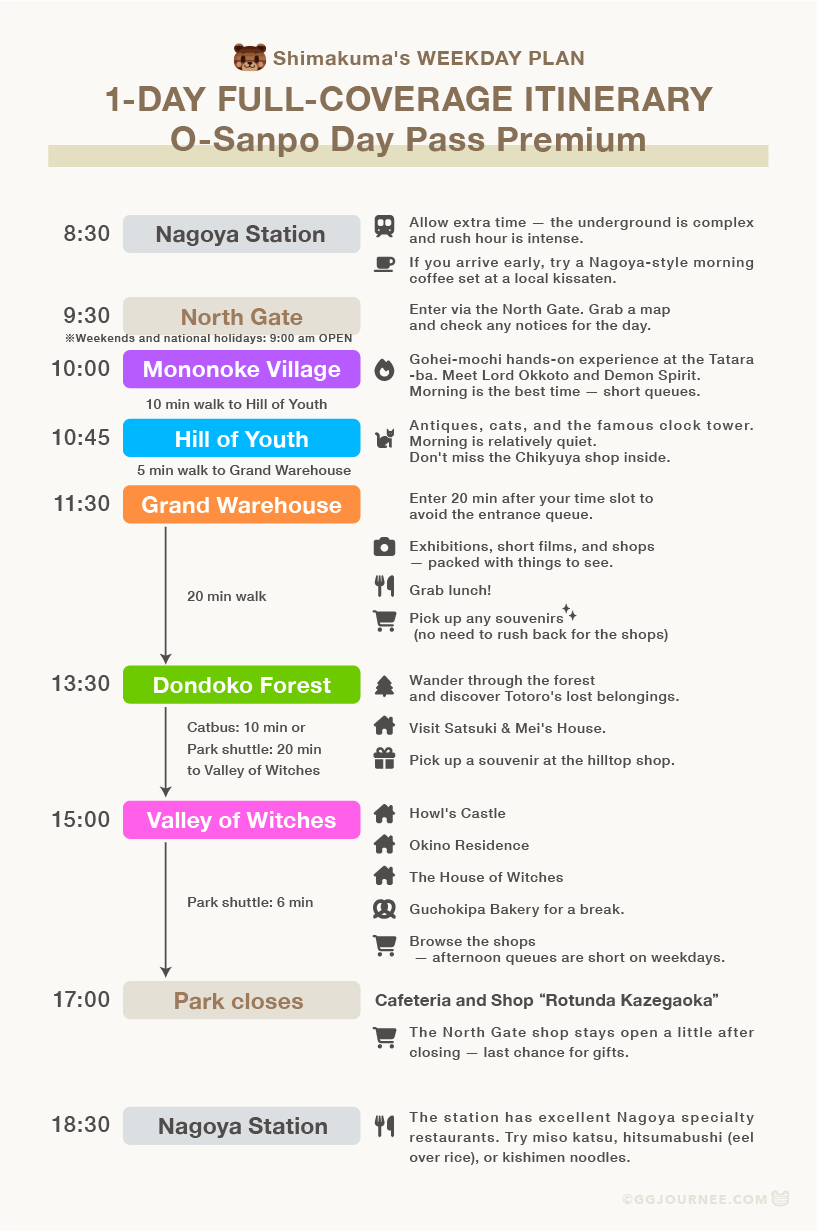
(Rough flow: Start at Mononoke Village → Grand Warehouse → Lunch in Free Area → Valley of Witches → Hill of Youth or Dondoko Forest in the late afternoon)
Option B: Two-Day Itinerary 🐻 Recommended!
This is the plan I genuinely recommend. Spreading the visit across two days gives you enough breathing room to actually enjoy both the Grand Warehouse and the Valley of Witches without feeling like you’re running a race. The illustrated itinerary is available in the Japanese version of this article.
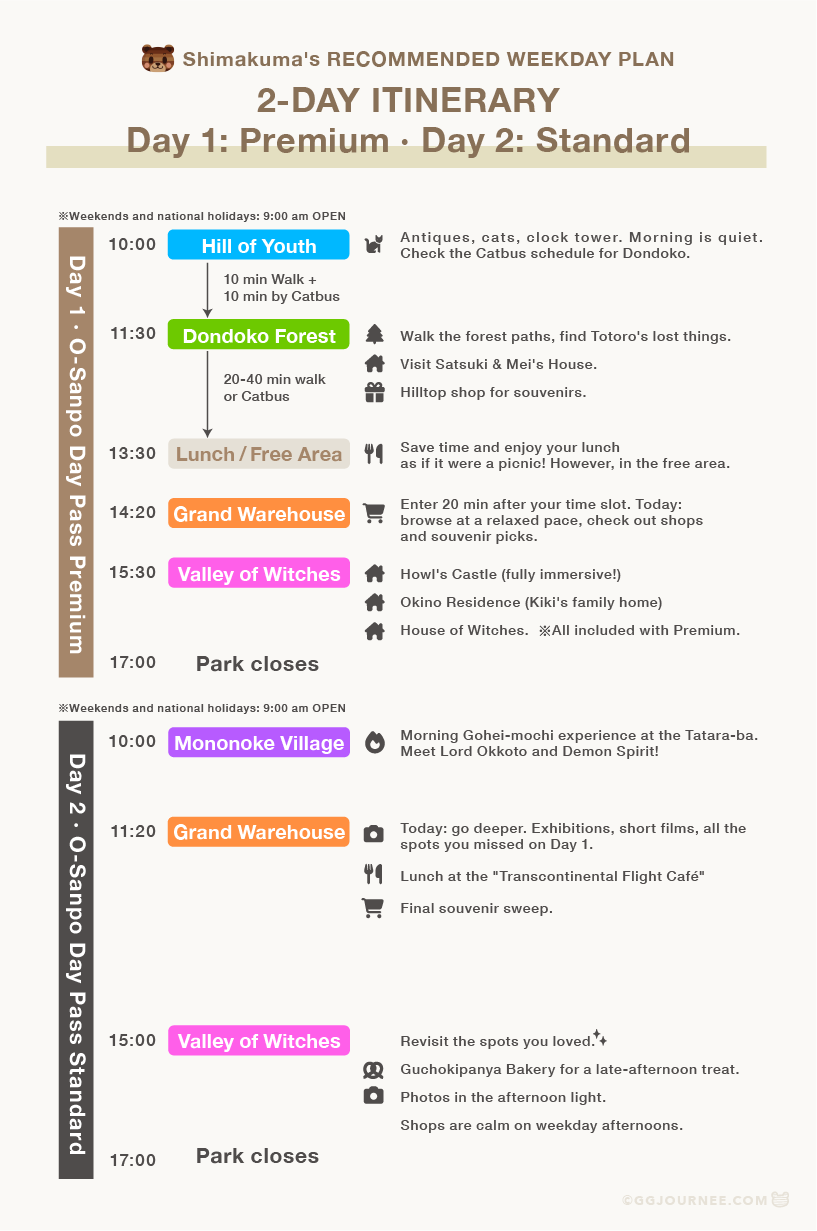
The two-day format also leaves room for proper photo time — and trust me, you’ll want it. So many visitors come in Ghibli-inspired outfits (gainen-code — character concept coordination), and the photo opportunities throughout the park are wonderful.

Note : Rain Gears and Ghibli Style Outfits

Ghibli Park is actually located in a mountainous area. Mountain weather is highly unpredictable—even if it’s perfectly sunny in the morning, you might get hit by heavy rain in the afternoon. You need to be especially prepared from April to October, when it’s very humid and prone to rain. Since the park’s main concept is “taking a stroll,” expect to walk a lot. Some areas feature unpaved, natural grassy paths, so I highly recommend wearing waterproof sneakers.

 ポチップ
ポチップ

In Japan, rain gear is an absolute must. You really can’t underestimate the mountain weather! At higher elevations, there’s a risk of lightning, making umbrellas unsafe, so a raincoat is essential. In fact, when I had my umbrella open at the observation deck, a Ghibli Park staff member kindly warned me, “Umbrellas can be dangerous up here, so please be careful.” Right now, poncho-style raincoats are super popular in Japan. You can even wear them right over your bag. Highly recommended!

 ポチップ
ポチップ

Hunting for dinner after returning from Ghibli Park is a lot of fun. But by that time, your feet will be completely wrecked! I went straight back to my hotel directly connected to Nagoya Station and changed into my recovery sandals to soothe my tired feet. These were an absolute lifesaver! Seriously, I can’t recommend them enough. Plus, if you’re just walking around inside the station building, it doesn’t even matter if it’s raining outside!
Trust me, you’ll want a pair of these after a full day on your feet.


This is the actual outfit I wore to Ghibli Park. Channeling my inner Kiki made the experience feel so special! Actually, I wasn’t the only one—there were so many people there dressed in character-inspired outfits just like me.
 ポチップ
ポチップ
It’s important to note that this isn’t exactly “cosplay.” In Japan, we call this “Gainen-code” (Concept Coordination). Instead of a full costume replica, it’s about capturing the vibe of the character—a “Kiki-inspired” look. It’s subtle enough to fit into everyday fashion, so you can walk right out of the park and onto the train without looking out of place. I highly recommend giving it a try!
New at Ghibli Park 🐷✨
A life-sized Savoia S.21 — the iconic flying boat from Porco Rosso — has moved from a travelling exhibition in Tokyo to a permanent location at Ghibli Park. It’s situated near the North Gate (Rotunda Kaze-ga-Oka), and there’s a possibility you’ll be able to see it without a park ticket. Highly worth checking on your visit.

© 1992 Hayao Miyazaki/Studio Ghibli, NN
Quick Reference for International Visitors
| Language inside the park | Japanese |
| Tickets (international) | see Ticket Section above |
| Nearest station | Nagakute Station (Linimo line) — take Higashiyama Line from Nagoya to Fujigaoka, transfer to Linimo |
| Best days to visit | Weekdays in spring or autumn; avoid Japanese public holidays |
| Payment | Most shops accept IC cards (Suica/Manaca) and major credit cards |
| Trash | No bins in the park — take everything home |
| Luggage | Coin lockers available at Nagoya Station; hotel storage recommended |
Have a wonderful Ghibli adventure! 🐾
Update
- 2026/04/02 Added: Poncho Information
- 2026/04/02 Added. next article What to Wear to Ghibli Park: Ghibli-Inspired Outfits & Items I Actually Saw There